AI at Maarch: How Our R&D Team Uses It Every Day – Meet Nicolas Le Bozec

← Back

In the digital age, new technologies are emerging at a rapid pace, making artificial intelligence (AI) an omnipresent topic. While it promises considerable advances, its integration — particularly in software development — still sparks controversy. At Maarch, we’ve chosen to integrate AI as a development support tool within our R&D teams.

But how can we make sure this tool is used securely and managed properly?

To answer this question and detail our approach, we interviewed Nicolas Le Bozec, junior backend developer. In this article, he explains how AI is actually used within Maarch’s R&D, with a focus on internal security and the rigorous management of this technology.

Interview with Nicolas Le Bozec

Can you explain what AI is used for within Maarch’s R&D teams, and how it fits into your work processes?

First of all, you should know that we use the JetBrains¹ development tool, specifically PhpStorm². That’s mainly true for us as back-end developers. An AI licence is built in, which lets us use different models such as Claude, Gemini, ChatGPT and others.

We use AI in several ways. First for ideation: we can ask it to suggest implementation examples for a piece of development work, which helps us picture a possible approach.

AI also helps us fix bugs. If a piece of code isn’t working, we can ask it to identify what’s causing the issue and where the error lies. And if we want to go further, we can even ask it to run a failing unit test to analyse the root cause of the problem.

Today, all of this is far more automated than before, when AI was limited to generating text or answering questions.

AI can now carry out certain tasks on its own, but that’s still a work in progress. In R&D, we mainly use it to have a dialogue with it, not to let it modify the code directly, because that could create security issues. It could change something without us wanting it to, or without us even noticing, which would be risky.

Our real goal is to stay in control of the code and of what gets done. For now, AI is therefore used as an assistant: it supports us in our development work, helps us get unstuck in certain situations and lets us be more efficient, in particular by going straight to online documentation to find what we need. It’s a real time-saver when it comes to research.

Which tasks does AI save you the most time on day to day?

In practical terms, AI mainly lets us move faster on our development work. We can take on more tickets per sprint, because we’re more efficient at solving problems. Blockers that would have taken us a long time to analyse can now be identified much faster. We still own the fixes, but AI helps us pinpoint the source of issues more quickly.

For developing new features, AI also saves us time. Since there are so many different files, it helps us quickly identify which one we need to work in, without going through a lengthy research or thinking phase. By analysing the project structure, it can even help us sort or spot the relevant files more efficiently.

Beyond these uses, are there other tasks AI can help with today?

The tasks mentioned earlier are clearly the « safest » ones. AI can now generate code, meaning it can modify existing code directly, but since this is still very new, it’s risky to trust it completely. It still makes the occasional mistake.

What are the risks or limitations to consider when giving AI a bigger role in the code?

It raises ethical questions, since it could gain access to the entire codebase³,  including environment files containing private keys or other sensitive information. So giving Artificial Intelligence full access doesn’t strike me as a very good idea.

Right now, it can modify pieces of code, but it needs to be restricted — for example, by telling it: « you can touch this file, but don’t go looking in the others. » It has to be limited and kept under control, because otherwise there can be major incidents: data leaks, or changes that could let a hacker access our systems and leak code. You have to be very vigilant when using AI, and that’s exactly what we do here.

You mentioned security concerns and the need to restrict AI. In practical terms, how do you ensure it only accesses authorised information?

We can see at all times which files it’s browsing and everything it’s doing — everything is kept under control. Internally, we mainly use conversational mode: we simply point it to the file we want it to work on. That way, we know it won’t go anywhere else, since it can only see that one file. We can even ask it to look at just one line of code or a specific element.

It only starts browsing other files if we explicitly ask it to search for a particular element in the code. In that case, it first analyses the file names to find the one matching the request, then reviews the code and chains together further analysis. Step by step, if it isn’t restricted, it could potentially end up accessing private keys or sensitive information needed for local development.

Do you think AI could eventually replace the developer role?

For my part, what I mainly do with AI is research and development. I run tests, try to see what works best, and look at how we can improve our working conditions to be more efficient…

I don’t think AI can fully replace developers, but it’s clearly transforming our profession. Today, it’s a bit like having a companion supporting us across a large number of tasks.

From your point of view, how is AI changing the developer role, and why do you think it won’t replace human expertise?

I think a developer today needs to know how to use AI and stay informed about the latest developments, because that matters — if only out of personal curiosity. That’s also the direction the profession is heading in.

I don’t believe AI will fully replace developers, at least not those who know how to use it. When you’ve mastered the tool, stay alert, and don’t let yourself get pulled into the risk of dependency, AI remains above all a tool for efficiency — one you need to keep an eye on.

That said, I understand why this might worry some people. Given how fast progress is moving, you can wonder whether, for cost or strategic reasons, some companies might be tempted to cut positions. But it really depends on each organisation, and some might ultimately realise they need to backtrack.

Before AI became part of your daily work, how did you go about researching documentation and technical solutions?

Before, we’d simply go to Stack Overflow to find people who’d run into the same problem as us.

How did you end up becoming, in a way, the AI go-to person within the R&D teams?

It’s very simple: I love new technology. I love discovering things, testing them, finding out more. Since AI was one of the emerging technologies when I joined Maarch, I got interested in it right away. I started using it, running tests, realising it could generate small code ideas, and I talked to my colleagues about it to explain its usefulness and how it worked.

Bit by bit, as AI kept improving, I carried on talking with them about it. I kept them updated on what I was discovering — the different AIs, French, American, Chinese — and everyone gradually started taking them into account, working with them and developing with them, until we decided to get JetBrains licences.

Today, AI is part of our everyday work. Since I keep myself informed about new developments, test what comes out, and think about what can or can’t be integrated into our working environment, I naturally became the team’s AI go-to person.


Definitions

¹ JetBrains

JetBrains is a company specialising in development tools, known for its powerful, intelligent working environments (IDEs). Its software is designed to help developers code faster, better and with fewer errors, thanks to advanced analysis and autocompletion features and, now, built-in AI.

² PhpStorm

PhpStorm is JetBrains’ IDE dedicated to PHP development. It offers a very fine-grained understanding of code, ultra-fast navigation, built-in tools for debugging, testing and managing complex projects, and native AI integration to support developers in their day-to-day tasks.

³ Codebase

A codebase refers to the entire source code of a project. It’s the technical foundation that brings together all the files, folders, modules and resources needed for an application to run. In short: it’s the heart of the software, the place where all the functionality lives.

Choose the open-source reference

More than 100,000 users already trust us!

Migrating from On-Premise to SaaS: What Are the Tangible Benefits for Your Organisation?

← Back

Document management is no longer a purely technical topic: it now touches on operational performance, compliance and security for organisations. In this context, the way a company hosts and operates its business solutions directly affects its ability to evolve, manage risk and optimise costs.

This is why many organisations are now re-evaluating their On-Premise infrastructure in favour of SaaS models, which are more resilient, more flexible and faster to deploy. At Maarch, this balance between ease of use and security requirements is part of our DNA. Every year, we invest more than €400,000 in information security, carry out regular audits, continuously strengthen the robustness of our platforms, and rely on trusted partners. This approach is particularly reflected in Maarch Courrier, where the share of SaaS deployments keeps growing.

In this article, we look back at the differences between On-Premise and SaaS but, more importantly, we explain how and why you should choose the SaaS option with Maarch.

Quickly Understanding the Two Models

On-Premise: A Model Built on Technical Sovereignty

The On-Premise model, or « on-site » hosting, relies on hosting the software within the organisation’s own infrastructure, through the purchase of a software licence to be installed directly on its own servers. It involves direct control over the entire technical chain: servers, security, updates, backups, service continuity. This model suits organisations that want to retain full control over their environments, their data and their security policies.

In short, the company owns and manages the entire chain, both software and hardware.

SaaS: A Service Operated and Designed for Agility

Software as a Service (SaaS) relies on software hosted in the cloud, accessible via a web browser, through a monthly or annual subscription, and fully operated by the publisher, such as Maarch, or by a specialist provider. Infrastructure, maintenance, updates and security are handled by the provider, allowing organisations to focus on usage rather than technical operations.

Why Some Organisations Still Favour On-Premise

Despite the rise of SaaS, On-Premise remains relevant in certain contexts, particularly for organisations subject to strict regulatory requirements or that want to keep full control over their IT environment.

Among the benefits: 

  • Full control: the company fully controls its infrastructure, data and configurations
  • Tailored security: internal teams can apply very specific security policies, adapted to the organisation’s own needs
  • Independence from the internet: the software remains accessible even with limited or unstable external connectivity
  • Single upfront investment: licence purchased under a CAPEX model, with no recurring subscription

The free, open-source nature of Maarch products allows this freedom to use On-Premise: we don’t force our clients into anything, and everyone chooses the mode that suits them best.
The simple architecture, built on widely proven low-level layers that are themselves open source, delivers the high maintainability that complex, proprietary product architectures often lack.

Why SaaS Is Becoming a Modern, Advantageous Standard

Better Cost Control

SaaS turns capital expenditure (CAPEX) into operating expenditure (OPEX). It removes costs related to infrastructure, energy, monitoring or breakdowns, and offers stable budget visibility through a subscription.

Immediate Adaptability

SaaS makes it possible to quickly adjust resources: users, storage, functional modules. This flexibility suits growing, multi-site organisations, or those engaged in modernisation efforts.

Continuous, Transparent Maintenance

Updates, security patches and functional improvements are deployed automatically. Internal teams are freed from operational tasks and can focus on high-value projects.

Enhanced Security

SaaS providers pool significant investments in cybersecurity, high availability and data protection, with a level of expertise often greater than what an SME can provide in-house. In addition, SLAs¹ guarantee contractual commitments on performance and availability.

¹ A SLA (Service Level Agreement) is a contractual document between a service provider and its client that precisely defines commitments regarding availability, performance and support. It also describes how this performance will be assessed and validated, as well as the measures planned if targets are not met.

The Added Value of SaaS with Maarch

Maarch’s SaaS offering stands out through a set of guarantees and services specifically designed to meet the expectations of CIOs and business teams. Choosing this deployment mode means capitalising on our expertise, while benefiting from an ultra-secure, high-performing environment that’s constantly enriched by open-source innovation. Our approach relies on a dedicated cloud infrastructure, guaranteeing high availability and full reversibility, including hosting, operations, 24/7 monitoring and automatic functional updates for our software solutions (Maarch Courrier, Maarch Digital Flow, etc.).

A Dedicated Team, Structured to Support CIOs

Choosing Maarch in SaaS mode means relying on a solid, specialised organisation:

  • 12 Xelians professionals dedicated to server infrastructure
  • 10 Maarch experts for the application layers
  • 2 CISOs focused on security and compliance

This structure guarantees clear oversight, sharp expertise and a fast response capability, without drawing on your internal teams.

A Major Investment in Security

Security is a measurable commitment. Maarch dedicates more than €400,000 per year to protecting its SaaS environments, including:

  • Regular scans and penetration tests
  • 24/7 monitoring and supervision by a SOC
  • Enhanced certifications
  • Advanced antivirus solutions
  • Bug bounty programmes to protect data

Performance Sized for Business Needs

Maarch’s certified infrastructure relies on a robust architecture including:

  • 10 servers per site
  • 140 GB of RAM combined capacity
  • 32 CPUs

This capacity guarantees high availability, smooth scaling and response times suited to demanding environments (document volumes, activity spikes, complex workflows…).

Premium Services Included as Standard

Maarch’s SaaS offering isn’t limited to hosting — it includes high-value services, with no additional cost or economic constraints, such as:

  • Automatic version management
  • Grafana analytics dashboards
  • Online editing via OnlyOffice Pro (shared)
  • Built-in Optical Character Recognition (OCR)
  • Automatic Document Reading (LAD) for mail
  • A Pro signing platform included

These features boost team productivity and reduce the number of integrations the IT department needs to manage.

IDP: A New Generation of Document Automation

SaaS also makes it possible to quickly roll out Maarch’s innovations, particularly around IDP (Intelligent Document Processing). We’re going to enrich our SaaS services with this intelligent processing tool:

  • Automatic extraction of the mail’s subject and date
  • Intelligent matching with an existing contact
  • Mail tone analysis (e.g. neutral, complaint, satisfaction)
  • Generation of mail summaries
  • Suggested automatic routing to the right departments
  • Identification of mail type (complaint, administrative, information request…)

These features speed up qualification, make processes more reliable and reduce low-value manual tasks.

IDP, which requires significant computing power due to its AI engine, becomes accessible at a moderate cost thanks to the resource pooling offered by the SaaS model.

SaaS… But Open Source: The Guarantee of Reverse Reversibility

Unlike proprietary SaaS solutions, Maarch keeps its open-source DNA. This approach offers a major, rare advantage: reverse reversibility.

You can move from On-Premise to SaaS, or go back to On-Premise on the core Product, without disruption, without technological lock-in and without necessarily changing solution.

For a CIO, this is the guarantee of staying in control of their architecture, their hosting choices and their long-term independence.

Conclusion

In conclusion, SaaS lets you focus fully on your core business, while Maarch ensures your information management tools remain high-performing, secure and constantly up to date. Migrating from On-Premise to SaaS goes beyond a simple hosting question: it involves performance, security, budget control and the ability of your information system to evolve.

With Maarch, you benefit from a robust, secure and scalable model, backed by expert teams and ongoing investment in cybersecurity. And because our DNA remains open source, you keep a decisive advantage: freedom. The freedom to adopt SaaS, but also the freedom to return to On-Premise if your needs change, without disruption or lock-in.

Choosing SaaS with Maarch means adopting a modern, sustainable and reversible solution, one that supports your organisation today while opening up strong prospects for tomorrow.

Choose the open-source reference

More than 100,000 users already trust us!

Migrer de l’On-Premise au SaaS : quels bénéfices concrets pour votre organisation ?

← Retour

Catégorie : Actualité • Article

Étiquette : GEC, GED, IDP, Intelligence artificielle, Migration des données, On-Premise, SaaS

Date : 24 avril 2026

Sandy Nelson

Chargée Marketing & Communication

La gestion documentaire n’est plus un simple sujet technique : elle touche désormais à la performance opérationnelle, à la conformité et à la sécurité des organisations. Dans ce contexte, la manière dont une entreprise héberge et opère ses solutions métiers influence directement sa capacité à évoluer, à maîtriser ses risques et à optimiser ses coûts.

C’est pourquoi de nombreuses organisations ré-évaluent aujourd’hui leurs infrastructures On‑Premise au profit de modèles SaaS, plus résilients, plus flexibles et plus rapides à déployer. Chez Maarch, cet équilibre entre simplicité d’usage et exigences de sécurité fait partie de notre ADN. Nous investissons chaque année plus de 400 000 € en SSI, menons des audits réguliers, renforçons en continu la robustesse de nos plateformes et nous appuyons sur des partenaires de confiance. Cette approche se reflète notamment dans Maarch Courrier, où la part des déploiements en SaaS ne cesse de croître.

Dans cet article, nous revenons sur les différences entre On‑Premise et SaaS mais, surtout, nous vous expliquons comment et pourquoi vous devriez opter pour le mode SaaS chez Maarch.

Comprendre rapidement les deux modèles

On-Premise : un modèle fondé sur la souveraineté technique

Le modèle On-Premise, ou « sur site », repose sur l’hébergement du logiciel au sein même de l’infrastructure de l’organisation, à travers l’achat d’une licence logicielle à installer directement sur ses propres serveurs. Il implique la maîtrise directe de l’ensemble de la chaîne technique : serveurs, sécurité, mises à jour, sauvegardes, continuité de service. Ce modèle répond aux organisations qui souhaitent conserver un contrôle total sur leurs environnements, leurs données et leurs politiques de sécurité.

En résumé, l’entreprise possède et administre l’ensemble de la chaîne, aussi bien logicielle que matérielle.

SaaS : un service opéré et pensé pour l’agilité

Le Software as a Service (SaaS) repose sur un logiciel hébergé dans le cloud, accessible via un navigateur web, grâce à un abonnement mensuel ou annuel, et entièrement opéré par l’éditeur, comme Maarch, ou par un prestataire spécialisé. L’infrastructure, la maintenance, les mises à jour et la sécurité sont prises en charge par le fournisseur, permettant aux organisations de se concentrer sur l’usage plutôt que sur l’exploitation technique.

Pourquoi certaines organisations privilégient encore le On-Premise

Malgré la montée en puissance du SaaS, le On‑Premise conserve une pertinence dans certains contextes, en particulier pour les organisations soumises à des exigences réglementaires strictes ou qui souhaitent garder un contrôle total sur leur environnement informatique.

Parmi les avantages : 

  • Maîtrise complète : l’entreprise contrôle entièrement son infrastructure, ses données et ses configurations
  • Sécurité sur mesure : les équipes internes peuvent appliquer des politiques de sécurité très spécifiques, adaptées aux besoins propres de l’organisation
  • Indépendance vis-à-vis d’Internet : le logiciel reste accessible même en cas de connexion externe limitée ou instable
  • Investissement initial unique : achat de la licence sous modèle CAPEX, sans abonnement récurrent

Le caractère libre et open source des produits Maarch autorise cette liberté d’usage en On-Premise : nous ne forçons pas nos clients et chacun choisit le mode qui lui convient le mieux.
L’architecture simple et basée sur des couches basses largement éprouvées, elles-mêmes open source, permet d’obtenir la haute-maintenabilité qui fait défaut à des architectures produit complexes et propriétaires.

Pourquoi le SaaS s’impose comme un standard moderne et avantageux

Une meilleure maîtrise des coûts

Le SaaS transforme les dépenses d’investissement (CAPEX) en dépenses d’exploitation (OPEX). Il supprime les coûts liés à l’infrastructure, à l’énergie, à la supervision ou aux pannes, et offre une visibilité budgétaire stable via un abonnement.

Une capacité d’adaptation immédiate

Le SaaS permet d’ajuster rapidement les ressources : utilisateurs, stockage, modules fonctionnels. Cette élasticité répond aux organisations en croissance, multisites ou engagées dans des démarches de modernisation.

Une maintenance continue et transparente

Les mises à jour, correctifs de sécurité et évolutions fonctionnelles sont déployés automatiquement. Les équipes internes sont libérées des tâches d’exploitation et peuvent se concentrer sur des projets à forte valeur ajoutée.

Un niveau de sécurité renforcé

Les fournisseurs de services SaaS mutualisent des investissements importants en cybersécurité, haute disponibilité et protection des données, avec un niveau d’expertise souvent supérieur à ce qu’une PME peut assurer en interne. De plus, les SLA¹ garantissent des engagements contractuels de performance et de disponibilité.

¹ Un SLA (Service Level Agreement), ou accord de niveau de service en français, est un document contractuel entre un fournisseur de services et son client qui définit précisément les engagements en matière de disponibilité, de performance et de support. Il décrit également la façon dont ces performances seront évaluées et validées, ainsi que les mesures prévues si les objectifs ne sont pas atteints.

La valeur ajoutée du SaaS avec Maarch

L’offre SaaS de Maarch se distingue par un ensemble de garanties et de services spécifiquement conçus pour répondre aux attentes des DSI et des métiers. Opter pour ce mode de déploiement c’est capitaliser sur notre expertise, tout en bénéficiant d’un environnement ultra-sécurisé, performant et constamment enrichi par l’innovation open source. Notre fonctionnement repose sur une infrastructure cloud dédiée, garantissant une haute disponibilité et réversibilité complète, incluant l’hébergement, l’exploitation, la supervision 24/7 et les mises à jour fonctionnelles automatiques de nos solutions logicielles (Maarch Courrier, Maarch Digital Flow, etc.).

Une équipe dédiée, structurée pour accompagner les DSI

Choisir Maarch en mode SaaS, c’est s’appuyer sur une organisation solide et spécialisée :

  • 12 professionnels Xelians dédiés à l’infrastructure serveur
  • 10 experts Maarch pour les couches applicatives
  • 2 RSSI focalisés sur la sécurité et la conformité

Cette structuration garantit un pilotage clair, une expertise pointue et une capacité d’intervention rapide, sans solliciter vos équipes internes.

Un investissement massif dans la sécurité

La sécurité est un engagement mesurable. Maarch consacre plus de 400 000 € par an à la protection de ses environnements SaaS, incluant :

  • Des scans réguliers et pentests
  • La surveillance et supervision 24/7 par un SOC
  • Des certifications renforcées
  • Des solutions antivirus avancées
  • Des programmes de bug bounty pour protéger les données

Des performances dimensionnées pour les usages métiers

L’infrastructure certifiée de Maarch repose sur une architecture robuste comprenant :

  • 10 serveurs par site
  • 140 Go de RAM de capacité cumulée
  • 32 CPU

Cette capacité garantit une haute disponibilité, une montée en charge fluide et des temps de réponse adaptés aux environnements exigeants (volumétrie documentaire, pics d’activité, workflows complexes…).

Des services premium inclus en version standard

Le SaaS Maarch ne se limite pas à l’hébergement, il intègre des services à forte valeur ajoutée, sans contraintes économiques et/ou surcoût, comme :

  • La gestion automatique des versions
  • Des tableaux de bord analytiques Grafana
  • L’édition en ligne via OnlyOffice Pro (mutualisé)
  • La reconnaissance optique de caractère (OCR) intégrée
  • Le traitement automatique des courriers (LAD)
  • Un parapheur Pro inclus

Ces éléments renforcent la productivité des équipes et réduisent les intégrations à gérer côté SI.

L’IDP : une nouvelle génération d’automatisation documentaire

Le SaaS permet aussi de déployer rapidement les innovations Maarch, notamment autour de l’IDP (Intelligent Document Processing). Nous allons enrichir nos services SaaS avec cet outil de traitement intelligent :

  • Extraction automatique de l’objet et de la date du courrier
  • Rapprochement intelligent avec un contact existant
  • Analyse de tonalité de courrier (exemple : neutre, réclamation, satisfaction)
  • Génération de résumés de courriers
  • Proposition de routage automatique vers les bons services
  • Identification du type de courrier (réclamation, administratif, demande d’info…)

Ces fonctionnalités accélèrent la qualification, fiabilisent les processus et réduisent les tâches manuelles à faible valeur ajoutée.

L’IDP, qui requiert une puissance de calcul importante en raison de son moteur IA, devient accessible à un coût modéré grâce à la mutualisation offerte par le mode SaaS.

Un SaaS… mais open source : la garantie d’une réversibilité inverse

Contrairement aux solutions SaaS propriétaires, Maarch conserve son ADN open source. Cette approche offre un avantage majeur rare : la réversibilité inverse.

Vous pouvez passer de l’On-Premise au Saas, ou revenir à l’On-Premise sur le cœur Produit, sans rupture, sans dépendance technologique et sans forcément changer de solution.

Pour un DSI, c’est la garantie de garder la main sur son architecture, ses choix d’hébergement et son indépendance à long terme.

Conclusion

En conclusion, le SaaS vous permet de vous concentrer pleinement sur votre cœur de métier, tandis que Maarch veille à ce que vos outils de gestion de l’information restent performants, sécurisés et constamment à jour. La migration de l’On‑Premise vers le SaaS dépasse la simple question d’hébergement : elle engage la performance, la sécurité, la maîtrise budgétaire et la capacité d’évolution du système d’information.

Avec Maarch, vous bénéficiez d’un modèle robuste, sécurisé et évolutif, soutenu par des équipes expertes et des investissements continus en cybersécurité. Et parce que notre ADN reste open source, vous conservez un avantage décisif : la liberté. La liberté d’adopter le SaaS, mais aussi celle de revenir à l’On‑Premise si vos besoins évoluent, sans rupture ni dépendance.

Opter pour le SaaS chez Maarch, c’est adopter une solution moderne, durable et réversible, qui accompagne votre organisation aujourd’hui tout en lui ouvrant de solides perspectives pour demain.

Adopter la référence open source

Plus de 100 000 utilisateurs nous font déjà confiance !

Le Traitement Intelligent des Documents (IDP) pour révolutionner la gestion de l’information

← Retour

Catégorie : Article

Étiquette : IDP, Innovation, Intelligence artificielle, Traitement Intelligent des Documents

Date : 26 mars 2026

Sandy Nelson

Chargée marketing & communication

L’ère numérique a engendré une prolifération exponentielle des données, dont une grande partie se trouve enfermée dans des documents parfois non structurés ou semi-structurés. Pour les entreprises cherchant à optimiser leurs opérations, le défi majeur réside dans l’extraction rapide et précise de ces informations cruciales. C’est ici qu’intervient le Traitement Intelligent des Documents – ou Intelligent Document Processing (IDP) en anglais – une technologie de rupture qui transforme la manière dont les organisations gèrent leurs flux documentaires.

Qu’est-ce que le Traitement Intelligent des Documents (IDP) ?

L’IDP est un ensemble de technologies qui automatisent l’extraction, la classification et la validation des données à partir de divers formats de documents (factures, bons de commande, formulaires, contrats, e-mails, etc.). Contrairement à la simple Reconnaissance Optique de Caractères (OCR) qui ne fait que convertir l’image du texte, l’IDP utilise l’intelligence artificielle pour comprendre le contenu et le contexte des documents.

Les Composantes Clés de l’IDP

Le succès de l’IDP repose sur la convergence de plusieurs technologies de pointe :

  • Reconnaissance Optique de Caractères (OCR) et Reconnaissance Intelligente de Caractères (ICR) : Convertissent les images de texte manuscrit ou imprimé en données numériques.
  • Traitement du Langage Naturel (NLP) : Permet à la machine de lire, de comprendre et d’interpréter le sens et la structure du texte (identification d’entités, classification, résumé).
  • Vision par Ordinateur (Computer Vision) : Permet de localiser et d’analyser les éléments visuels des documents, comme les cases à cocher, les tableaux, ou la mise en page.
  • Apprentissage Automatique (Machine Learning) et Apprentissage Profond (Deep Learning) : Ces technologies sont au cœur de l’IDP, permettant aux systèmes d’apprendre des données traitées, d’améliorer la précision au fil du temps et de s’adapter à de nouveaux types de documents sans programmation explicite.

Les avantages stratégiques de l’IDP

L’adoption de l’IDP n’est pas qu’une simple amélioration opérationnelle ; elle est une nécessité stratégique dans un environnement commercial axé sur l’efficacité et l’agilité.

1. Amélioration de l’efficacité opérationnelle

  • Réduction des tâches manuelles répétitives : l’automatisation du tri et de la saisie libère les employés des tâches fastidieuses et chronophages.
  • Accélération des processus : le temps de traitement d’un document est réduit de jours à quelques minutes ou secondes, accélérant des cycles critiques comme la comptabilité fournisseurs ou l’ouverture de comptes clients.

2. Augmentation de la précision et de la qualité des données

  • Diminution des erreurs humaines : les systèmes d’IDP surpassent largement la précision humaine pour l’extraction de données volumineuses.
  • Validation automatique : les outils IDP peuvent croiser les données extraites avec des bases de données internes (ERP, CRM) pour assurer la conformité et l’exactitude avant l’intégration.

3. Optimisation des coûts

En réduisant le besoin en intervention humaine pour le traitement des documents et en accélérant les flux, l’IDP génère des économies significatives sur les coûts de main-d’œuvre et les frais généraux.

4. Meilleure prise de décision

L’accès rapide à des données structurées et validées permet aux décideurs d’avoir une vue d’ensemble plus claire et plus actuelle de l’activité, facilitant des décisions éclairées.

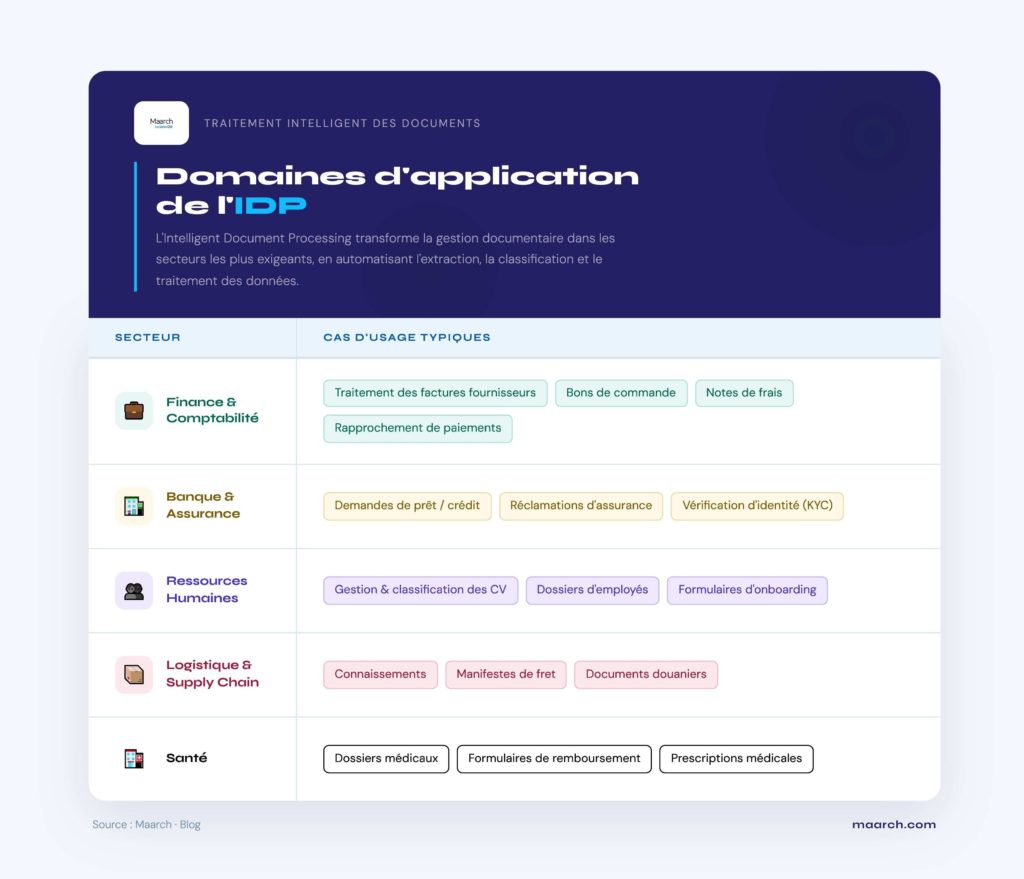
Domaines d’application de l’IDP

L’IDP trouve son utilité dans pratiquement tous les secteurs d’activité gérant d’importants volumes de documents :

Tableau — Domaines d’application de l’IDP.
Contenu généré avec l’IA. Claude by Anthropic.

L’avenir du Traitement Intelligent des Documents

L’IDP est en constante évolution. Les futures avancées se concentreront sur :

  • L’Hyper-automatisation : Intégration de l’IDP dans des flux de travail de Robotic Process Automation (RPA) plus larges pour automatiser des chaînes de processus de bout en bout.
  • L’exploitation des documents non structurés complexes : capacité accrue à extraire des informations pertinentes de documents très hétérogènes et textuels (contrats juridiques longs, rapports techniques).
  • Accessibilité accrue : des solutions cloud plus flexibles et des modèles pré-entraînés plus nombreux rendront l’IDP accessible aux PME, et pas seulement aux grandes entreprises.

L’IDP chez Maarch : du prototype au produit

Genèse du projet

L’IDP n’est pas pour Maarch une technologie découverte sur étagère. C’est un projet né de l’intérieur, initié par notre équipe de R&D avec un objectif clair : répondre concrètement aux enjeux d’automatisation du traitement documentaire que nos clients rencontrent au quotidien.

La vision initiale était ambitieuse mais précise : capturer les documents, extraire le texte, reconnaître, classifier, lire les informations clés et confier à la machine toutes les opérations à forte valeur ajoutée qui mobilisent aujourd’hui trop de temps humain. À terme, ce projet a vocation à remplacer Maarch Capture et Mercure, tout en ouvrant la voie aux technologies les plus avancées : Intelligence Artificielle, modèles de langage (LLM) et modèles de vision.

De l’idée au terrain : prototype et premiers POC

Les premiers travaux de R&D ont rapidement abouti à un prototype fonctionnel, bâti sur une architecture intégrant Apache Airflow pour l’orchestration des flux de traitement et des modèles d’IA déployés sur des serveurs Scaleway. C’est un choix délibéré, pour garantir la souveraineté des données et répondre aux exigences de sécurité de nos clients les plus sensibles.

Ce prototype a été mis à l’épreuve à l’occasion de projets de démonstration et de POC concrets, notamment pour Banque Neuflize et X-Act. Ces premières expérimentations ont permis de valider l’architecture technique et d’affiner la pertinence des modèles face à des cas d’usage réels.

Depuis décembre 2025, le projet a été repris et renforcé par la R&D et l’équipe technique de Nanterre, avec un objectif de production en ligne de mire : fiabiliser la chaîne de traitement, sécuriser l’architecture et construire un produit conforme aux standards les plus élevés en matière de fiabilité et de sécurité.

Le pilote Neuflize : la preuve par la mesure

La prochaine étape concrète est le déploiement d’un pilote en conditions réelles pour Neuflize. L’enjeu est direct : mesurer la pertinence des résultats produits par l’IDP en comparaison d’un traitement humain – en l’occurrence, le vidéocodage offshore actuellement en place.

C’est précisément le type de comparaison qui donne du sens à l’automatisation intelligente. Il ne s’agit pas de remplacer l’humain pour le principe, mais de démontrer que la machine peut atteindre, et dépasser, la précision d’un traitement manuel, tout en divisant les délais et les coûts de manière significative.

La feuille de route : des services concrets, une vision d’ensemble

Au-delà du pilote, Maarch a défini une feuille de route structurée autour de deux axes complémentaires.

Le premier axe porte sur Maarch Courrier, avec le développement de micro-services directement utiles au traitement du courrier entrant :

  • Extraction automatique des données d’indexation : émetteur, destinataire, objet, date
  • Génération d’un résumé du document
  • Évaluation de la tonalité (satisfaction, insatisfaction, urgence)
  • Enregistrement automatisé des courriers

Le second axe vise à poser les fondations du remplacement de Mercure, avec des services dédiés à la chaîne de capture : séparation par codes-barres et QR codes, suppression des pages blanches, OCR multi-moteurs (Tesseract, Tungsten) et reconnaissance de documents par machine learning.

Viendront ensuite des services à plus haute valeur ajoutée – capture de mails, routage automatique, intégration dans des offres BPO – tous conçus pour être utilisés aussi bien en amont de nos produits qu’en mode stand-alone, pour une intégration plus profonde dans l’écosystème Maarch.

Une architecture pensée pour la production, pas pour la démonstration

Ce qui distingue l’approche Maarch, c’est le soin apporté à la robustesse du socle technique dès le départ. La sécurisation des accès aux services GPU et LLM, le suivi de consommation, le monitoring de la plateforme et la supervision des flux ne sont pas des préoccupations ajoutées après coup ; elles font partie intégrante de la feuille de route.

Car nos clients, qu’il s’agisse d’une banque privée, d’une collectivité ou d’un opérateur BPO, attendent un système prévisible, auditable et maintenu dans la durée. C’est exactement ce que nous construisons.

Conclusion

L’IDP est un levier de transformation et Maarch, votre partenaire pour le déployer

En définitif, le Traitement Intelligent des Documents est une réponse structurelle à un problème que toutes les organisations connaissent : des volumes documentaires qui croissent plus vite que les capacités humaines à les traiter, des données précieuses enfouies dans des formats non structurés et des processus manuels qui freinent la réactivité opérationnelle.

L’IDP apporte une réponse concrète à chacun de ces enjeux, à condition d’être déployé avec rigueur, ancré dans des cas d’usage réels et construit sur une architecture fiable.

C’est exactement la trajectoire que Maarch a choisie : un développement maîtrisé, initié en interne, éprouvé sur le terrain avec des clients exigeants et pensé pour s’intégrer naturellement dans l’écosystème documentaire que nous construisons depuis des années. De Maarch Courrier aux futures évolutions qui remplaceront probablement Mercure et Maarch Capture, l’IDP n’est pas un module ajouté, c’est le fil conducteur d’une vision produit cohérente.

Pour nos clients, cela se traduit concrètement par un accompagnement vers une transformation durable et efficace : celle qui permet à une organisation de passer d’une gestion subie de ses documents à une exploitation active et intelligente de son information.

Les premières briques sont posées. Les premiers résultats arrivent. Et la feuille de route est claire.

Si vous souhaitez comprendre comment l’IDP peut s’appliquer à vos flux documentaires, nos équipes sont disponibles pour en discuter.

Adopter la référence open source

Plus de 100 000 utilisateurs nous font déjà confiance !

Intelligent Document Processing (IDP): Transforming Information Management

← Back

The digital age has led to an exponential proliferation of data, much of it locked away in documents that are sometimes unstructured or semi-structured. For businesses looking to optimise their operations, the major challenge lies in extracting this crucial information quickly and accurately. This is where Intelligent Document Processing (IDP) comes in — a disruptive technology that is transforming the way organisations manage their document workflows.

What Is Intelligent Document Processing (IDP)?

IDP is a set of technologies that automate the extraction, classification and validation of data from various document formats (invoices, purchase orders, forms, contracts, emails, etc.). Unlike simple Optical Character Recognition (OCR), which merely converts a text image, IDP uses artificial intelligence to understand the content and context of documents.

The Key Components of IDP

The success of IDP relies on the convergence of several cutting-edge technologies:

  • Optical Character Recognition (OCR) and Intelligent Character Recognition (ICR): Convert images of handwritten or printed text into digital data.
  • Natural Language Processing (NLP): Allows the machine to read, understand and interpret the meaning and structure of text (entity recognition, classification, summarisation).
  • Computer Vision: Locates and analyses the visual elements of documents, such as checkboxes, tables or page layout.
  • Machine Learning and Deep Learning: These technologies are at the heart of IDP, allowing systems to learn from processed data, improve accuracy over time and adapt to new document types without explicit programming.

The Strategic Benefits of IDP

Adopting IDP is not just an operational improvement; it’s a strategic necessity in a business environment focused on efficiency and agility.

1. Improved Operational Efficiency

  • Reduced repetitive manual tasks: automating sorting and data entry frees employees from tedious, time-consuming work.
  • Faster processes: document processing time is cut from days to minutes or even seconds, speeding up critical cycles such as accounts payable or client account opening.

2. Increased Data Accuracy and Quality

  • Fewer human errors: IDP systems far outperform human accuracy when extracting large volumes of data.
  • Automatic validation: IDP tools can cross-reference extracted data with internal databases (ERP, CRM) to ensure compliance and accuracy before integration.

3. Cost Optimisation

By reducing the need for human intervention in document processing and speeding up workflows, IDP generates significant savings on labour costs and overheads.

4. Better Decision-Making

Fast access to structured, validated data gives decision-makers a clearer, more up-to-date overview of the business, enabling informed decisions.

Areas of Application for IDP

IDP proves useful in virtually every industry that manages large volumes of documents:

Table — Areas of application for IDP.
Content generated with AI. Claude by Anthropic.

The Future of Intelligent Document Processing

IDP is constantly evolving. Future advances will focus on:

  • Hyperautomation: Integrating IDP into broader Robotic Process Automation (RPA) workflows to automate end-to-end process chains.
  • Handling complex unstructured documents: greater ability to extract relevant information from highly varied, text-heavy documents (long legal contracts, technical reports).
  • Greater accessibility: more flexible cloud solutions and a wider range of pre-trained models will make IDP accessible to SMEs, not just large enterprises.

IDP at Maarch: From Prototype to Product

Origins of the Project

For Maarch, IDP isn’t an off-the-shelf technology. It’s a project born in-house, launched by our R&D team with a clear goal: to provide a concrete response to the document-processing automation challenges our clients face every day.

The initial vision was ambitious yet precise: capture documents, extract text, recognise, classify, read key information, and hand over to the machine all the high-value operations that currently take up too much human time. In time, this project is intended to replace Maarch Capture and Mercure, while paving the way for the most advanced technologies: artificial intelligence, large language models (LLMs) and vision models.

From Idea to Field: Prototype and First POCs

Early R&D work quickly led to a functional prototype, built on an architecture combining Apache Airflow for orchestrating processing flows with AI models deployed on Scaleway servers. This was a deliberate choice, to guarantee data sovereignty and meet the security requirements of our most sensitive clients.

This prototype was put to the test through demonstration projects and concrete POCs, notably for Banque Neuflize and X-Act. These initial trials validated the technical architecture and helped refine the relevance of the models against real-world use cases.

Since December 2025, the project has been taken over and reinforced by the R&D and technical teams in Nanterre, with production firmly in sight: making the processing chain more reliable, securing the architecture and building a product that meets the highest standards of reliability and security.

The Neuflize Pilot: Proof Through Measurement

The next concrete step is the deployment of a real-world pilot for Neuflize. The goal is straightforward: to measure the relevance of the results produced by IDP against human processing — in this case, the offshore video coding currently in place.

This is exactly the kind of comparison that gives intelligent automation its meaning. It’s not about replacing humans as a matter of principle, but about demonstrating that a machine can match, and even exceed, the accuracy of manual processing, while significantly cutting both timeframes and costs.

The Roadmap: Concrete Services, a Big-Picture Vision

Beyond the pilot, Maarch has defined a roadmap structured around two complementary strands.

The first strand focuses on Maarch Courrier, with the development of micro-services directly useful for processing incoming mail:

  • Automatic extraction of indexing data: sender, recipient, subject, date
  • Generation of a document summary
  • Tone assessment (satisfaction, dissatisfaction, urgency)
  • Automated mail registration

The second strand aims to lay the foundations for replacing Mercure, with services dedicated to the capture chain: barcode and QR code separation, blank page removal, multi-engine OCR (Tesseract, Tungsten) and machine-learning document recognition.

Higher value-added services will follow — email capture, automatic routing, integration into BPO offerings — all designed to be used both upstream of our products and in stand-alone mode, for deeper integration into the Maarch ecosystem.

An Architecture Built for Production, Not for Demonstration

What sets Maarch’s approach apart is the care taken over the robustness of the technical foundation from the outset. Securing access to GPU and LLM services, tracking usage, monitoring the platform and overseeing data flows are not afterthoughts; they are an integral part of the roadmap.

Because our clients — whether a private bank, a local authority or a BPO operator — expect a system that is predictable, auditable and maintained over the long term. That’s exactly what we’re building.

Conclusion

IDP is a lever for transformation, and Maarch is your partner in deploying it

Ultimately, Intelligent Document Processing is a structural response to a problem every organisation knows well: document volumes growing faster than human capacity to process them, valuable data buried in unstructured formats, and manual processes that hold back operational responsiveness.

IDP provides a concrete answer to each of these challenges, provided it is deployed rigorously, grounded in real use cases and built on a reliable architecture.

This is exactly the path Maarch has chosen: a controlled development, launched in-house, tested in the field with demanding clients, and designed to fit naturally into the document ecosystem we’ve been building for years. From Maarch Courrier to the future developments that will likely replace Mercure and Maarch Capture, IDP is not a bolt-on module — it’s the connecting thread of a coherent product vision.

For our clients, this translates concretely into support towards a lasting, effective transformation: one that allows an organisation to move from passively managing its documents to actively and intelligently making the most of its information.

The first building blocks are in place. The first results are coming in. And the roadmap is clear.

If you’d like to understand how IDP can apply to your document workflows, our teams are available to discuss it.

Choose the open-source reference

More than 100,000 users already trust us!