Article • March 26, 2026
Intelligent Document Processing (IDP): Transforming Information Management
This article has been viewed 87 times
The digital age has led to an exponential proliferation of data, much of it locked away in documents that are sometimes unstructured or semi-structured. For businesses looking to optimise their operations, the major challenge lies in extracting this crucial information quickly and accurately. This is where Intelligent Document Processing (IDP) comes in — a disruptive technology that is transforming the way organisations manage their document workflows.
What Is Intelligent Document Processing (IDP)?
IDP is a set of technologies that automate the extraction, classification and validation of data from various document formats (invoices, purchase orders, forms, contracts, emails, etc.). Unlike simple Optical Character Recognition (OCR), which merely converts a text image, IDP uses artificial intelligence to understand the content and context of documents.
The Key Components of IDP
The success of IDP relies on the convergence of several cutting-edge technologies:
- Optical Character Recognition (OCR) and Intelligent Character Recognition (ICR): Convert images of handwritten or printed text into digital data.
- Natural Language Processing (NLP): Allows the machine to read, understand and interpret the meaning and structure of text (entity recognition, classification, summarisation).
- Computer Vision: Locates and analyses the visual elements of documents, such as checkboxes, tables or page layout.
- Machine Learning and Deep Learning: These technologies are at the heart of IDP, allowing systems to learn from processed data, improve accuracy over time and adapt to new document types without explicit programming.
The Strategic Benefits of IDP
Adopting IDP is not just an operational improvement; it’s a strategic necessity in a business environment focused on efficiency and agility.
1. Improved Operational Efficiency
- Reduced repetitive manual tasks: automating sorting and data entry frees employees from tedious, time-consuming work.
- Faster processes: document processing time is cut from days to minutes or even seconds, speeding up critical cycles such as accounts payable or client account opening.
2. Increased Data Accuracy and Quality
- Fewer human errors: IDP systems far outperform human accuracy when extracting large volumes of data.
- Automatic validation: IDP tools can cross-reference extracted data with internal databases (ERP, CRM) to ensure compliance and accuracy before integration.
3. Cost Optimisation
By reducing the need for human intervention in document processing and speeding up workflows, IDP generates significant savings on labour costs and overheads.
4. Better Decision-Making
Fast access to structured, validated data gives decision-makers a clearer, more up-to-date overview of the business, enabling informed decisions.
Areas of Application for IDP
IDP proves useful in virtually every industry that manages large volumes of documents:
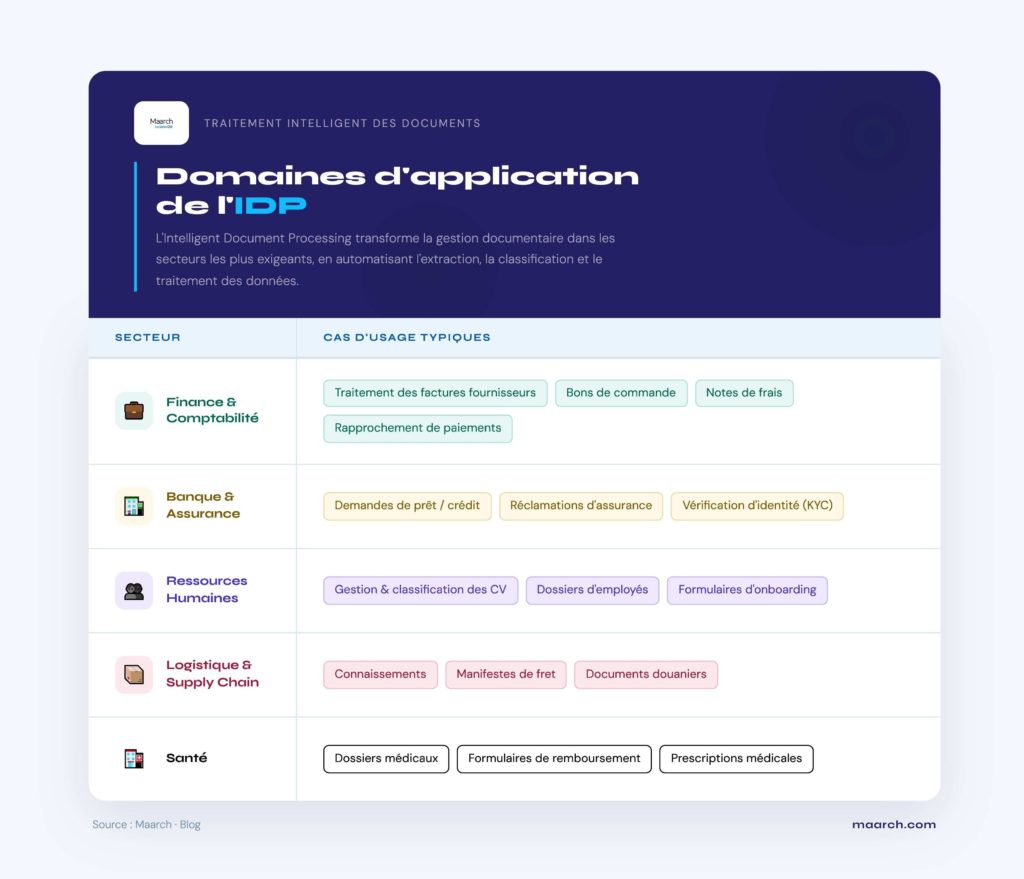
Table — Areas of application for IDP.
Content generated with AI. Claude by Anthropic.
The Future of Intelligent Document Processing
IDP is constantly evolving. Future advances will focus on:
- Hyperautomation: Integrating IDP into broader Robotic Process Automation (RPA) workflows to automate end-to-end process chains.
- Handling complex unstructured documents: greater ability to extract relevant information from highly varied, text-heavy documents (long legal contracts, technical reports).
- Greater accessibility: more flexible cloud solutions and a wider range of pre-trained models will make IDP accessible to SMEs, not just large enterprises.
IDP at Maarch: From Prototype to Product
Origins of the Project
For Maarch, IDP isn’t an off-the-shelf technology. It’s a project born in-house, launched by our R&D team with a clear goal: to provide a concrete response to the document-processing automation challenges our clients face every day.
The initial vision was ambitious yet precise: capture documents, extract text, recognise, classify, read key information, and hand over to the machine all the high-value operations that currently take up too much human time. In time, this project is intended to replace Maarch Capture and Mercure, while paving the way for the most advanced technologies: artificial intelligence, large language models (LLMs) and vision models.
From Idea to Field: Prototype and First POCs
Early R&D work quickly led to a functional prototype, built on an architecture combining Apache Airflow for orchestrating processing flows with AI models deployed on Scaleway servers. This was a deliberate choice, to guarantee data sovereignty and meet the security requirements of our most sensitive clients.
This prototype was put to the test through demonstration projects and concrete POCs, notably for Banque Neuflize and X-Act. These initial trials validated the technical architecture and helped refine the relevance of the models against real-world use cases.
Since December 2025, the project has been taken over and reinforced by the R&D and technical teams in Nanterre, with production firmly in sight: making the processing chain more reliable, securing the architecture and building a product that meets the highest standards of reliability and security.
The Neuflize Pilot: Proof Through Measurement
The next concrete step is the deployment of a real-world pilot for Neuflize. The goal is straightforward: to measure the relevance of the results produced by IDP against human processing — in this case, the offshore video coding currently in place.
This is exactly the kind of comparison that gives intelligent automation its meaning. It’s not about replacing humans as a matter of principle, but about demonstrating that a machine can match, and even exceed, the accuracy of manual processing, while significantly cutting both timeframes and costs.
The Roadmap: Concrete Services, a Big-Picture Vision
Beyond the pilot, Maarch has defined a roadmap structured around two complementary strands.
The first strand focuses on Maarch Courrier, with the development of micro-services directly useful for processing incoming mail:
- Automatic extraction of indexing data: sender, recipient, subject, date
- Generation of a document summary
- Tone assessment (satisfaction, dissatisfaction, urgency)
- Automated mail registration
The second strand aims to lay the foundations for replacing Mercure, with services dedicated to the capture chain: barcode and QR code separation, blank page removal, multi-engine OCR (Tesseract, Tungsten) and machine-learning document recognition.
Higher value-added services will follow — email capture, automatic routing, integration into BPO offerings — all designed to be used both upstream of our products and in stand-alone mode, for deeper integration into the Maarch ecosystem.
An Architecture Built for Production, Not for Demonstration
What sets Maarch’s approach apart is the care taken over the robustness of the technical foundation from the outset. Securing access to GPU and LLM services, tracking usage, monitoring the platform and overseeing data flows are not afterthoughts; they are an integral part of the roadmap.
Because our clients — whether a private bank, a local authority or a BPO operator — expect a system that is predictable, auditable and maintained over the long term. That’s exactly what we’re building.
Conclusion
IDP is a lever for transformation, and Maarch is your partner in deploying it
Ultimately, Intelligent Document Processing is a structural response to a problem every organisation knows well: document volumes growing faster than human capacity to process them, valuable data buried in unstructured formats, and manual processes that hold back operational responsiveness.
IDP provides a concrete answer to each of these challenges, provided it is deployed rigorously, grounded in real use cases and built on a reliable architecture.
This is exactly the path Maarch has chosen: a controlled development, launched in-house, tested in the field with demanding clients, and designed to fit naturally into the document ecosystem we’ve been building for years. From Maarch Courrier to the future developments that will likely replace Mercure and Maarch Capture, IDP is not a bolt-on module — it’s the connecting thread of a coherent product vision.
For our clients, this translates concretely into support towards a lasting, effective transformation: one that allows an organisation to move from passively managing its documents to actively and intelligently making the most of its information.
The first building blocks are in place. The first results are coming in. And the roadmap is clear.
If you’d like to understand how IDP can apply to your document workflows, our teams are available to discuss it.
Dive deeper into the Maarch ecosystem







Choose the open-source reference
More than 100,000 users already trust us!