Case study • November 28, 2024
Maarch Courrier at Orléans Métropole
This article has been viewed 39 times

The Orléans Métropole project with Maarch Courrier
Orléans Métropole deploys various shared resource schemes, such as joint procurement groups and shared services (e.g., IT, waste management…), in order to streamline resources and improve collaboration between municipalities.
Orléans Métropole, an inter-municipal structure made up of 22 municipalities and home to more than 292,000 residents, was granted Métropole status in May 2017.
The local government reform introduced by the law of December 16, 2010 reinforced this approach by encouraging the creation of shared services and the pooling of resources, with the aim of optimizing costs and aligning working methods.
For example, in terms of software, Cart@DS software was rolled out across all 22 municipalities, for managing urban planning and housing files.
Maarch and mail management
As early as 2018, the Metropolitan Authority decided to provide member municipalities with the Maarch Courrier solution, a free, open-source, and 100% French software. This choice came after an in-depth technical study, which highlighted its scalability and suitability for their needs.
Because of Maarch Courrier’s free and open-source nature, and given the conclusions of the technical study, the Metropolitan Authority was entitled to enter into an exclusive contract with Maarch Courrier’s publisher, in accordance with Article 30 of the French public procurement code, with the aim of having future developments incorporated into the product’s standard version.
To date, Maarch Courrier is used by 14 municipalities: Chécy , Fleury-les-Aubrais, Ingré, La Chapelle Saint Mesmin, Mardié, Olivet, Ormet, Saint-Cyr-En Val, Semoy, Saint-Hilaire Saint – Mesmin, Saint- Jean le Braye, Saint- Jean le Blanc, Saint- Jean de la ruelle, Saint-Pryvé Saint-Masmin.
Implementation choices
The mail management project using Maarch Courrier is a textbook example of implementation in a shared environment. With the right human and technical resources in place, Orléans Métropole chose to host the service in its own data center — in other words, On-Premise.
This choice has never been reconsidered since 2018 — the same is true for many large Public Establishments for Inter-Municipal Cooperation (EPCI) that have the resources needed to host this type of project on their own servers.
We therefore opted to create a shared instance for the city and the Metropolitan Authority, making it easier to exchange mail between the two entities via a simple redirect and a custom field indicating scope.
On the other hand, each member municipality has its own instance, also hosted in the Metropolitan Authority’s data center. The town of Fleury-les-Aubrais also chose to communicate with the Metropolitan Authority through the « Maarch2Maarch« mechanism.
For example, a piece of mail concerning a road maintenance issue in Fleury-les-Aubrais is forwarded to the Metropolitan Authority for processing, since road maintenance falls under inter-municipal jurisdiction.
This mechanism allows the town of Fleury-les-Aubrais to track the progress of the request, ensuring effective collaboration with Orléans Métropole.
GEC at cruising speed
Since 2018, Maarch Courrier has been fully operational within Orléans Métropole, across 14 of the 22 municipalities that have signed up for the service.
These municipalities vary in size and population, ranging from a few thousand to several tens of thousands of residents.
During the project phase, specific configuration templates were created for small and medium-sized municipalities, allowing the Metropolitan Authority’s teams to handle deployment entirely on their own.
The dedicated, self-sufficient electronic mail management (GEC) team consists of three people, each with specific part-time responsibilities to maintain and evolve the system, including:
- An IT project manager (IT department)
- A business project manager, based within the General Secretariat, who provides support to smaller municipalities, since the larger ones are relatively self-sufficient.
- An application manager (IT department) handling configuration, updates, and tier-2 technical support
Thanks to the scripts and documentation provided by Maarch, the team carries out regular software updates. Each year, around 20,000 pieces of mail are logged in the shared instance used by the city and the Metropolitan Authority.
Overall, the functional scope was correctly defined from the outset and has changed very little since, aside from a few configuration adjustments such as managing supervision queues, validation steps, and maintaining reference data.
One notable development is the integration of the IXBus SRCI connector, which allows the master copy of a document to be sent to the signing platform for signature. Indeed, as far as we know, IXParapheur is the only signing platform that allows a document to be modified before signing, provided it has the master copy.
Architecture
At Orléans Métropole, the Maarch Courrier application runs on a single server under Ubuntu Server 22.04 LTS, while the database is hosted separately on a dedicated server running Postgres 12.
The application is accessible from outside the network solely to allow users to connect from outside the Metropolitan Authority’s network, as is also the case for other applications. In terms of application scope.
Orléans Métropole scrupulously follows Maarch’s recommendations regarding updates.
As part of system access management, each municipality has a dedicated administrator responsible for account configuration. This person handles the creation of user accounts and the assignment of access rights.
For external access, a secure connection is set up via a reverse proxy, making it possible to expose the necessary services while protecting the internal network. In terms of infrastructure, Orléans Métropole uses Simplivity virtualization, which ensures optimized resource management and high availability.
Lastly, the project’s architecture relies on dedicated servers: specific servers are assigned to database management and application management respectively, allowing tasks to be separated and improving system performance. Performance has remained at a satisfactory level, even as load has increased, thanks to server upgrades carried out by the local authority during the project.
1,683 active users have handled more than 248,093 pieces of mail logged in their Maarch Courrier instance since February 2010.
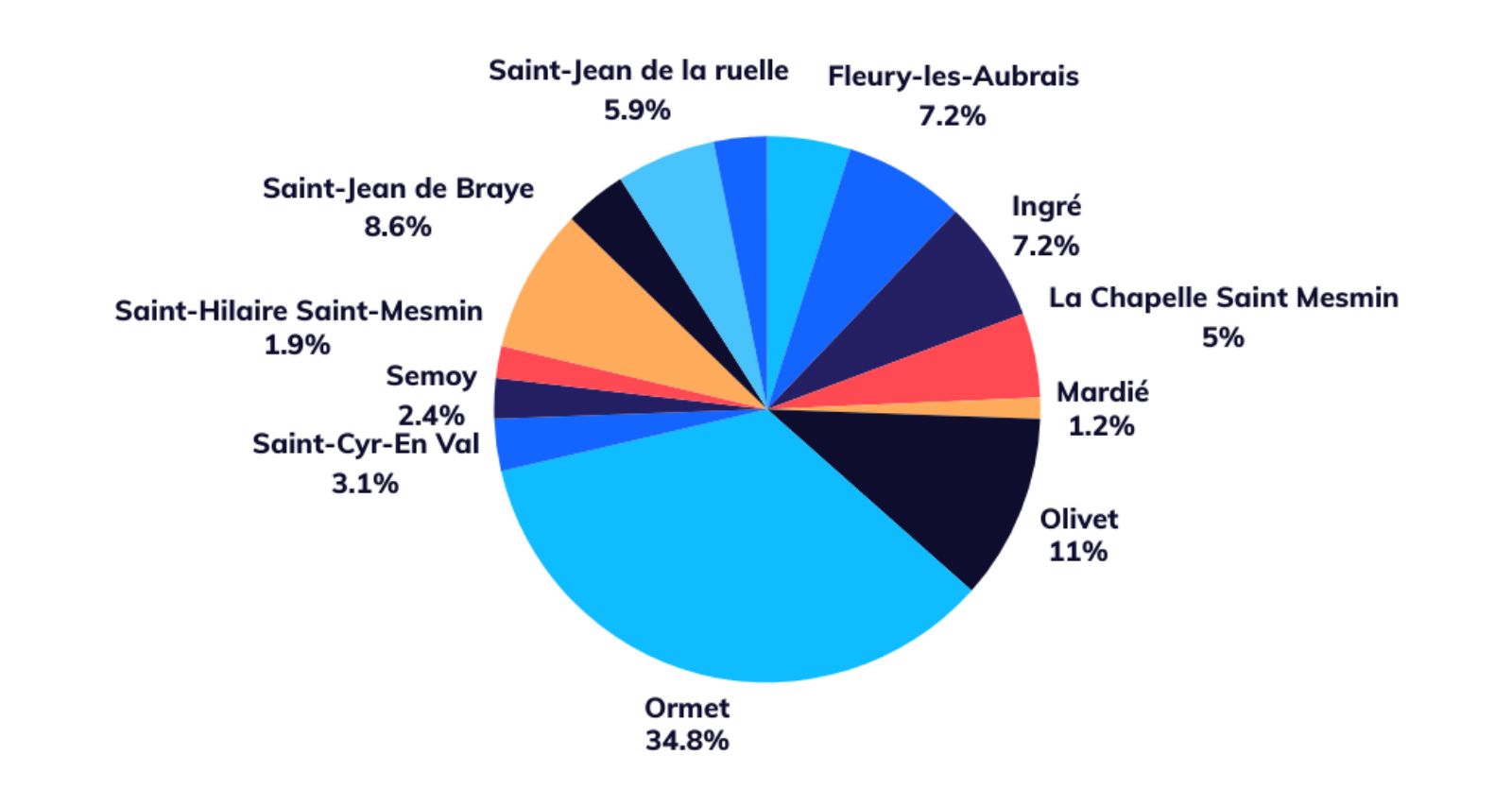
Breakdown of users by total volume of mail per town in Orléans Métropole
To optimize the scanning of incoming mail, the Metropolitan Authority uses three Fujitsu ScanSnap scanners and has assigned two operators to process around 30 paper items per day. Capturing emails from a folder on the Exchange server, combined with scanning paper mail, made it possible to digitize around 20,000 pieces of mail in 2023, compared with 15,700 so far in 2024.
Christelle Bonnivard’s testimonial :
Orléans Métropole and its 22 municipalities are home to more than 282,000 residents within an urban area of 430,000 people, a territory experiencing strong population growth. Of these municipalities, 14 chose to take part in the Maarch project.
The Metropolitan Authority wanted to set up a reliable mail-tracking system to respond to residents within a set deadline.
Thanks to the Maarch Courrier software, we have full traceability of mail, from receipt through to closure, with the ability to track progress by adding annotations.
Maarch enables full digitization, in particular for sending acknowledgments of receipt by email, digital signing via Ixbus, and replying directly through Maarch, removing the need for another piece of software to send email replies. The tool also makes it possible to communicate with certain municipalities within the Metropolitan Authority thanks to the Maarch2Maarch module.
Next challenge
In the near future, Orléans Métropole plans to migrate to Postgres 16 and find a virtualization system other than VMware.
The city of Orléans could be interested in Maarch Courrier V24, which offers new features such as the Maarchie artificial intelligence, which helps draft outgoing emails, with the aim of improving the efficiency of inter-municipal processes.
Closing words
Orléans Métropole’s GEC is a perfect illustration of the relevance of an open-source solution like Maarch Courrier: free deployment, ownership, contribution, and rallying around a shared project. In the face of inevitable budget tightening, it’s a way to do more with less public money. Our times call on us to rethink the way we operate, and open source is one of the keys to optimizing budgets while reclaiming our sovereignty.
Jean-Louis Ercolani – Founder & CEO, Maarch

Maarch Courrier
Take mail management to the next level, with advanced data controls and an intuitive interface.
Learn more →Dive deeper into the Maarch ecosystem







Choose the open-source reference
More than 100,000 users already trust us!