Case study • August 13, 2025
Deployment of Maarch Courrier in the Municipality of Châtillon: A Successful Transition to Digital Correspondence Management
This article has been viewed 27 times

To modernize the processing of its mail and ensure the sustainability of communications, the City of Châtillon decided, in May 2023, to begin the process of implementing a digitalized mail management solution. To this end, a complete overhaul of the GEC system was initiated. The goal was to move to an automated, secure solution capable of centralizing and managing both paper mail and emails.
A strategic choice for centralized, secure mail management
After extensive benchmarking and analysis of quotes from several providers, the City of Châtillon chose the Maarch Courrier solution in January 2024.
This choice was driven by the quality of the tool — particularly its ergonomics — the project methodology presented, the support offered by Maarch throughout the project’s implementation, a reasonable cost, and positive, successful feedback from other local authorities.
The goal was to centralize the management of mail, whether paper or electronic, by establishing efficient approval workflows while ensuring full traceability and long-term reliability of internal and external communications.
Maarch Courrier was selected for its ability to automate and secure the management of incoming and outgoing mail flows.
Among these key features are Mail Capture, a tool that automatically captures and centralizes emails and scanned paper documents in a single interface, as well as the interoperability of the “I Parapheur” connector from publisher Libriciel SCOP.
A structured implementation
The business process was adjusted to match the specific workflow of the City of Châtillon’s mail department, made up of 3 mail clerks responsible for entering records and scanning incoming mail and emails from the “mairie” mailbox captured via Mail Capture, all overseen by a department head.
These letters and emails are then reviewed at a “mail supervision” level by the general administration and subsequently assigned to the relevant departments after approval from the “N2 supervisor” (the Mayor’s office) and the “N3 supervisor” (DGS).
The solution was also configured to include an internal approval workflow dedicated exclusively to internal memos, before they are distributed to the various municipal departments.
This custom configuration made it possible to automate workflows while complying with the local authority’s own approval procedures.
Hosted in SaaS mode, the solution guarantees both data confidentiality and the scalability needed to meet future requirements.
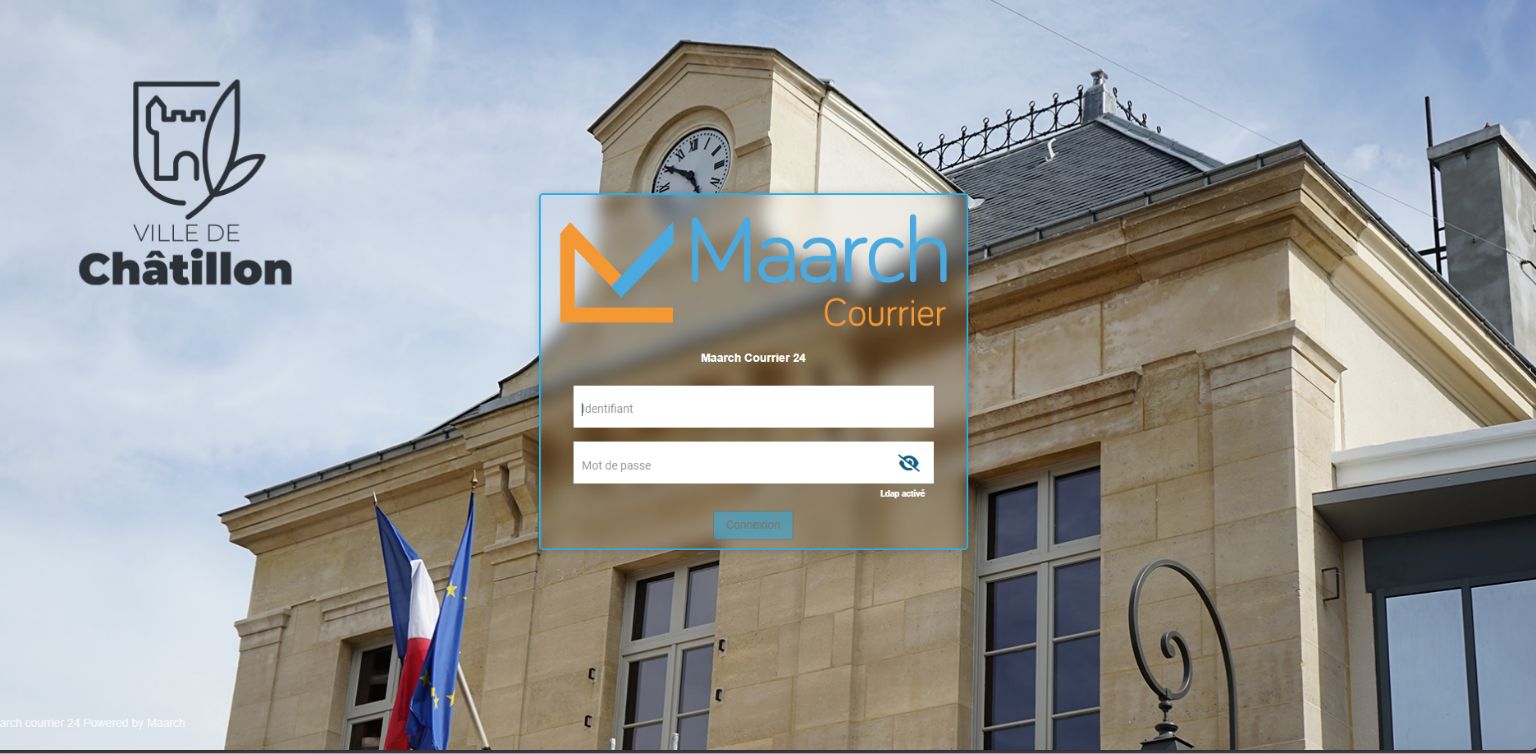
The project’s implementation followed a structured timeline:
- Design: gathering requirements and developing a prototype specific to the City of Châtillon.
- Configuration: integrating internal approval workflows and various complex processes, tailored to business requirements.
- Testing: a phase of user testing validated after several iterations, accompanied by training sessions.
- Go-live: launching production after adjustments made in response to user feedback.
A smooth transition thanks to targeted training
The transition went smoothly, and every effort was made to secure strong buy-in from users.
Out of 222 users of the solution, 100 were trained — nearly one in two users, which is highly significant and played an important role in staff buy-in for the project.
Training took place over eight days, in person at the local authority’s premises, which allowed for smoother exchanges than videoconferencing and better attention from participants. The high-quality training sessions were tailored to each staff member’s level of use.
As a result, there were 4 types of training:
- “scan operator” training,
- “administrator” training,
- “user” training,
- “manager” training.
Change management support played a decisive role in the project’s success. The solution was adopted by users, helped by its ease of use and the relevance of its features.
Immediate benefits and future prospects
Maarch’s project manager remained consistently available throughout the deployment phase and after go-live to support users as they built up their skills. Their feedback allowed for minor adjustments to be made during the first few weeks of use.
Since going into production on December 16, 2024, more than 4,500 incoming letters have been processed, at an average of 600 letters per month.
The benefits are numerous, such as improved traceability through data centralization — users can track the status of each letter in real time, reducing the risk of lost documents.
In terms of time savings, automated approval has reduced mail processing times, providing a faster response to residents.
As for optimized ergonomics, many users appreciate the clarity of the interface, which allows for faster and more efficient mail management, with feedback highlighting significant time savings.
A scalable solution, the SaaS platform ensures flexibility and security, making it possible to add new features as needed and ensuring continuous adaptation to evolving business needs.
Looking ahead, the City of Châtillon is open to exploring and receiving demonstrations of new features offered by version 24 of Maarch Courrier, particularly the integration of artificial intelligence to suggest pre-drafted responses and further automate certain outgoing response processes.
A successful project with positive feedback
This project illustrates the City of Châtillon’s commitment to modernizing its internal processes in order to offer more responsive service, better traceability, and long-term reliability adapted to its organizational and business specifics. Thanks to the Maarch Courrier solution, the city now has a system that is both well-suited and scalable, meeting the local authority’s expectations.
Key data and indicators:
- Project launch date: January 2024
- Go-live date: December 16, 2024
- Number of users: 222 users
- Mail processed since go-live: More than 4,500 letters (approximately 600 per month)
- Training duration: 8 days (100 users trained)
Conclusion
Implementing a project like this requires a strong commitment and availability from the client, but also from the project manager, who had to listen closely and find quick, tailored solutions for the local authority — which was indeed the case.
It is essential for the local authority to do upfront work, before the project begins, on its processing and approval workflows, and to be clear about the organization it wants to adopt for managing incoming and outgoing mail, so that this information can be passed on to Maarch Courrier.
The testing phase is crucial — it’s very important to run tests to verify that the workflows are correct and that letters flow properly into the right queues… The idea is to fix as much as possible before going into production, so that go-live happens under the best possible conditions and users have as refined a solution as possible.
During this phase, Henri Queneau, the project manager, was present and made himself available to work with the town and make the necessary adjustments. He was highly invested in following the project through.
Maarch support (via the phone line or the Forge platform) is available and quickly resolves common usage issues.
This zero-data-migration mail digitalization project at the City of Châtillon illustrates Maarch’s ability to adapt to a specific business context while delivering a high-performing, scalable solution. Thanks to rigorous management of the transition, the City of Châtillon now has a secure, traceable, and easy-to-use electronic mail management system.
This project stands as a solid reference for mail management in local authorities.
Finally, this is a project that must keep evolving, be monitored over time, and be well managed on a daily basis to ensure its longevity.
Dive deeper into the Maarch ecosystem







Choose the open-source reference
More than 100,000 users already trust us!